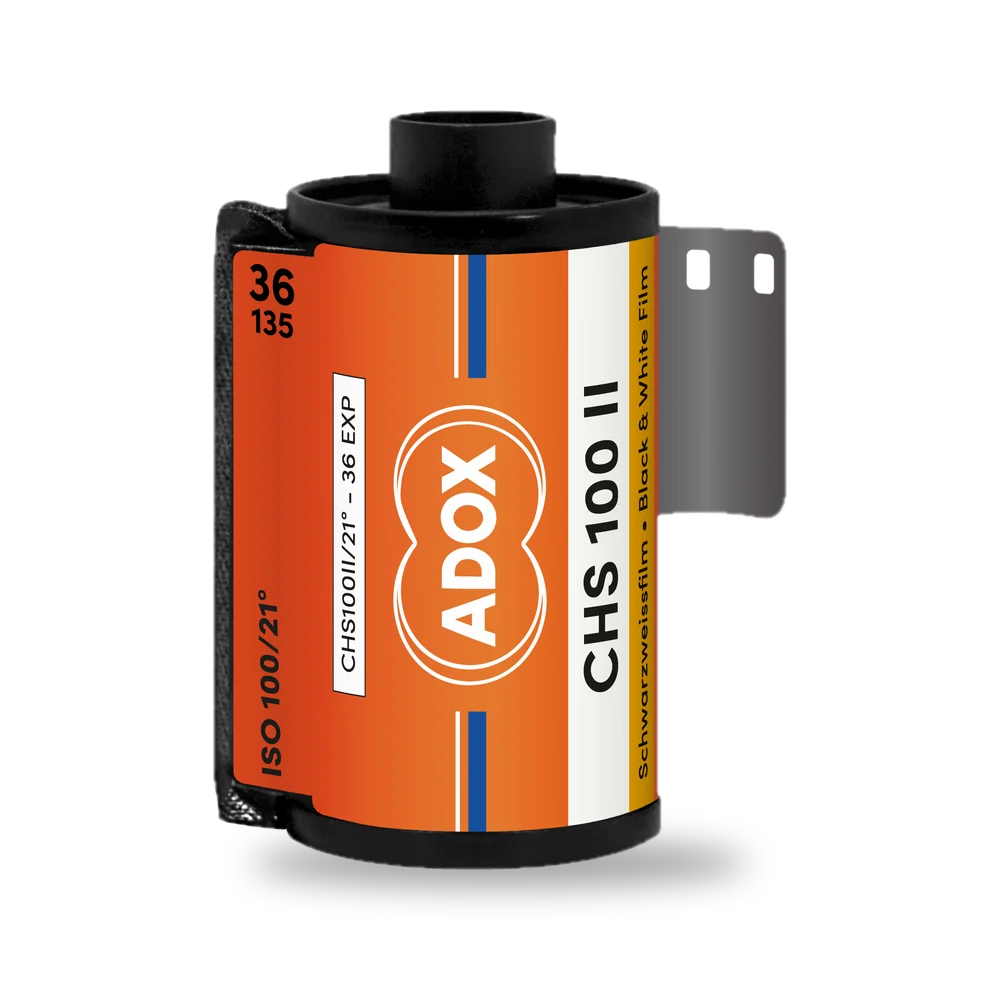
A genuine classic emulsion black-and-white film, and one of the very few still in production. Adox introduced CHS 100 II in 2014 to fill the gap left when Fotokemika in Croatia shut down and took the old Efke emulsions with it — the same emulsions Adox had sold for years as CHS Art. Rather than reviving that exact recipe, Adox developed a new single-layer, silver-rich cubic-grain emulsion coated in Germany, keeping the character of the originals while improving consistency and handling.The single-layer construction is the film's point. Modern emulsions stack several layers of differing sensitivity to build contrast and tame highlights; CHS 100 II doesn't, which gives it a long, unhurried tonal scale, high acutance, and a rendering that reads as mid-century rather than contemporary. Panchromatic with sensitivity extending unusually far into the red. Available in 35mm, 120, and sheet formats, including large and ultra-large sizes.
CHS 100 II
Spezifikation
Tabelle 1- Nennempfindlichkeit (ISO)
- 100
- Prozess
- S/W
- Status
- In Produktion
- Erstmals erschienen
- 2013
- Verfügbare Formate
- keine Angabe
- TrägerFilmträger Der klare, flexible Träger, der die Emulsion trägt. Mehr im Glossar lesen ›
- PET
- EmulsionEmulsion Die lichtempfindliche Schicht eines Films: winzige Silberhalogenid-Kristalle in Gelatine. Mehr im Glossar lesen ›
- Hybrid
- Spektrale EmpfindlichkeitSpektrale Empfindlichkeit Auf welche Lichtfarben ein Film anspricht und wie stark. Mehr im Glossar lesen ›
-
Orthochromatisch – was das bedeutet
Empfindlich für Blau und Grün, aber praktisch blind für Rot. Rot wird sehr dunkel und Blau hell, weshalb Hautunreinheiten hervortreten und Himmel ausbleichen. Dafür lässt er sich unter tiefrotem Dunkelkammerlicht handhaben, sodass man ihm beim Entwickeln zusehen kann.
- Körnigkeit (RMS)Korn Die sichtbare, sandartige Struktur in einer Fotografie, die von den Silber- oder Farbstoffklumpen herrührt, die das Bild bilden. Mehr im Glossar lesen ›
- keine Angabe
- Auflösungsvermögen, Linienpaare / mm
- keine Angabe
- Maximale DichteDichte Wie viel Licht ein Negativ, Dia oder Abzug sperrt. Mehr im Glossar lesen ›
- keine Angabe
- Spielraum nach obenBelichtungsspielraum Wie weit ein Film über- oder unterbelichtet werden kann und noch ein brauchbares Ergebnis liefert. Mehr im Glossar lesen ›
- keine Angabe
- Spielraum nach unten
- keine Angabe
Ein Strich bedeutet, dass der Wert nicht aus einem Datenblatt abgelesen wurde. Nichts ist hier geschätzt.
Entwicklungszeiten
Im Rechner öffnen ›Belichtet mit — Nennempfindlichkeit markiert
Zeige 2 von 42 veröffentlichten Zeiten.
| Entwickler | Verdünnung | EI | Temp. | Zeit | Kippen | Quelle |
|---|---|---|---|---|---|---|
| Silvermax Developer | 1+19 20,0 °C | 125 Push um 0,25 Blenden | 10:00 | — | ||
| Silvermax Developer | 1+19 20,0 °C | 125 Push um 0,25 Blenden | 10:00 | — |
Entwicklungszeiten nach Entwickler
14 Entwickler- Atomal 49 — CHS 100 II in Atomal 49 4
- D-76 — CHS 100 II in D-76 6
- FX-39 Type II — CHS 100 II in FX-39 Type II 3
- Fomadon Excel W27 — CHS 100 II in Fomadon Excel W27 1
- Fomadon LQN — CHS 100 II in Fomadon LQN 1
- Fomadon P — CHS 100 II in Fomadon P 1
- Fomadon R09 — CHS 100 II in Fomadon R09 1
- HC-110 — CHS 100 II in HC-110 6
- HRX — CHS 100 II in HRX 1
- ID-11 — CHS 100 II in ID-11 3
- Ilfotec DD-X — CHS 100 II in Ilfotec DD-X 2
- Rodinal — CHS 100 II in Rodinal 7
- Silvermax Developer — CHS 100 II in Silvermax Developer 4
- XTOL — CHS 100 II in XTOL 2
Charakter
Tonality: long, gently rising curve with generous shoulder. Highlights hold on much longer than a modern 100-speed film before blocking up; midtones are where it separates best.
Grain: cubic, clearly visible, sharp-edged rather than mushy. Not fine by modern standards — closer to the look of a 1960s emulsion than to Delta or T-Max.
Sharpness: excellent. The thin single-layer coating gives strong edge definition, which is a large part of why the grain reads as crisp rather than soft.Red sensitivity: extended, so reds and warm skin render lighter than expected and skies go paler without a filter. A yellow or orange filter has a stronger effect here than on most panchromatic films.
Glow: highlights bloom slightly around hard light sources — a characteristic of thin classic emulsions and a large part of why people choose it.
Latitude: wide on the overexposure side, less forgiving under. Many shooters rate it at EI 50–80 to open the shadows.
Developers: Rodinal/Adonal 1+50 is the traditional pairing and emphasises the sharpness and grain. Atomal 49 or D-76/ID-11 tames the grain and gives a softer, more compact scale. XT-3 sits between.
Handling: the emulsion is softer than modern films. Wash and squeegee carefully; avoid hardening-free workflows getting warm, and expect 120 to curl.
Best suited to: landscape, architecture, still life, portraiture in soft light — subjects with long tonal ranges and time to expose carefully. Less suited to fast handheld work or scenes needing clean shadow detail at box speed.
In one line: the closest thing currently in production to what black and white film looked like before multi-layer coating.
Link zu dieser Seite
0 Bewertungen
Von Fotografen unter ihrem eigenen Profil geschrieben – so sehen Sie, was sie fotografieren, bevor Sie abwägen, was sie sagen.
Zeit vorschlagen oder Fehler melden
Kennen Sie eine Zeit für CHS 100 II, die hier fehlt, oder haben Sie eine falsche entdeckt? Teilen Sie sie uns mit Quelle mit, und ein Kurator prüft sie.
- Nur Quellen. Wir veröffentlichen eine Zeit nur, wenn sie aus einer Primärquelle abgelesen wurde: dem Datenblatt oder der Tabelle des Herstellers. Ein Link dorthin ermöglicht uns, Ihre zu prüfen.
- Nichts geht von selbst online. Jede Meldung wird von einer Person gelesen, bevor sich etwas auf der Seite ändert.
- Kein Konto nötig. Name und E-Mail-Adresse sind optional und dienen nur dazu, Ihnen zu antworten.
0 Kommentare
Hinweise, wie sich dies in der Praxis verhält – was es im Einsatz leistet, zählt so viel wie das, was das Datenblatt sagt.
Noch keine Kommentare. Seien Sie der Erste und sagen Sie, wie er sich wirklich verhält.