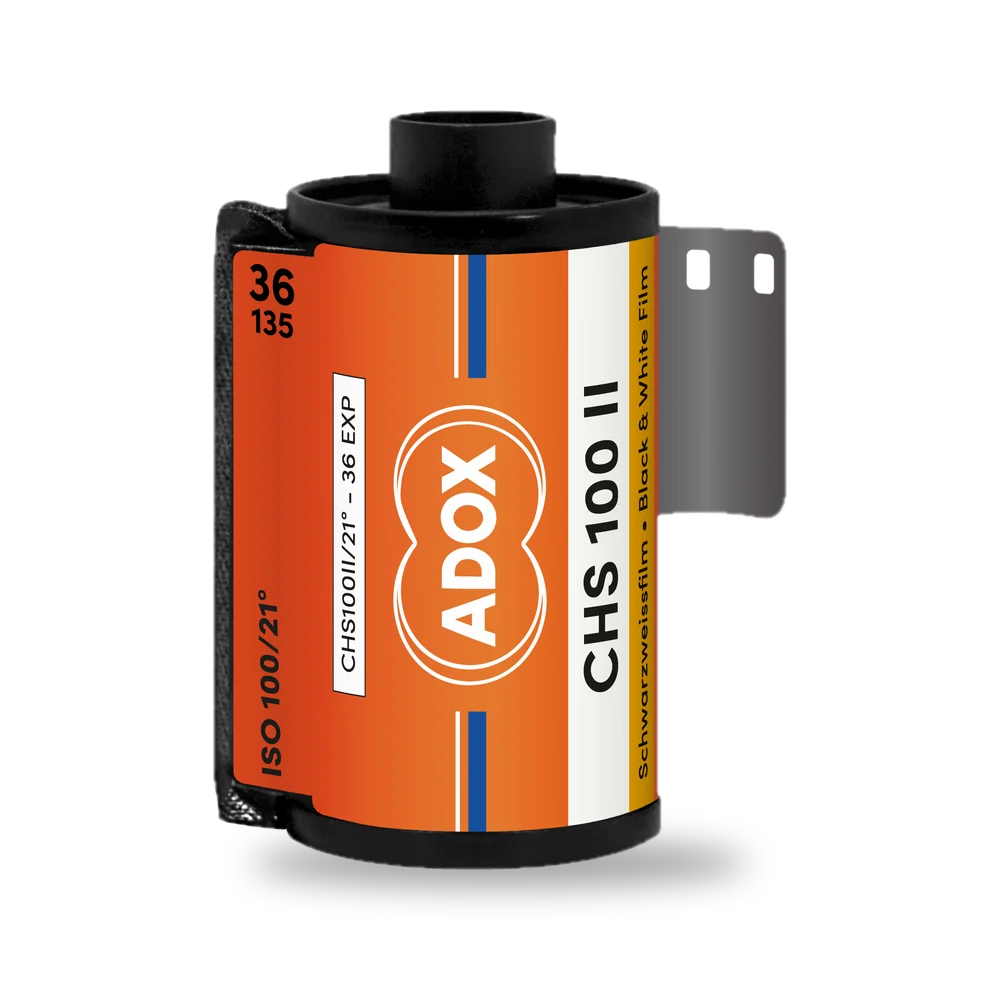
A genuine classic emulsion black-and-white film, and one of the very few still in production. Adox introduced CHS 100 II in 2014 to fill the gap left when Fotokemika in Croatia shut down and took the old Efke emulsions with it — the same emulsions Adox had sold for years as CHS Art. Rather than reviving that exact recipe, Adox developed a new single-layer, silver-rich cubic-grain emulsion coated in Germany, keeping the character of the originals while improving consistency and handling.The single-layer construction is the film's point. Modern emulsions stack several layers of differing sensitivity to build contrast and tame highlights; CHS 100 II doesn't, which gives it a long, unhurried tonal scale, high acutance, and a rendering that reads as mid-century rather than contemporary. Panchromatic with sensitivity extending unusually far into the red. Available in 35mm, 120, and sheet formats, including large and ultra-large sizes.
CHS 100 II
Specyfikacja
Tabela 1- Czułość nominalna
- 100
- Proces
- Cz.-b.
- Status
- W produkcji
- Wprowadzony na rynek
- 2013
- Dostępne formaty
- brak danych
- PodłożePodłoże filmu Przezroczysty, elastyczny nośnik, na którym leży emulsja. Więcej w słowniku ›
- PET
- EmulsjaEmulsja Światłoczuła warstwa filmu: drobne kryształki halogenku srebra w żelatynie. Więcej w słowniku ›
- Hybrydowa
- Czułość spektralnaCzułość spektralna Na jakie barwy światła film reaguje i jak silnie. Więcej w słowniku ›
-
Ortochromatyczna — co to oznacza
Czuły na niebieski i zielony, ale praktycznie ślepy na czerwień. Czerwienie wychodzą bardzo ciemne, a błękity jasne — dlatego skazy na skórze rzucają się w oczy, a niebo jest wyprane. W zamian można go obrabiać przy ciemnoczerwonym świetle ciemniowym i patrzeć, jak się wywołuje.
- Ziarnistość (RMS)Ziarno Widoczna, piaskowa struktura zdjęcia, pochodząca ze skupisk srebra lub barwnika tworzących obraz. Więcej w słowniku ›
- brak danych
- Zdolność rozdzielcza, par linii / mm
- brak danych
- Gęstość maksymalnaGęstość optyczna Ile światła zatrzymuje negatyw, przezrocze lub odbitka. Więcej w słowniku ›
- brak danych
- Tolerancja prześwietleniaTolerancja naświetlenia O ile film można prześwietlić lub niedoświetlić i nadal uzyskać użyteczny wynik. Więcej w słowniku ›
- brak danych
- Tolerancja niedoświetlenia
- brak danych
Kreska oznacza, że wartości nie odczytano z karty technicznej. Nic tu nie jest szacowane.
Czasy wywoływania
Otwórz w kalkulatorze ›Naświetlany jako — czułość nominalna zaznaczona
Pokazano 2 z 42 opublikowanych czasów.
| Wywoływacz | Rozcieńczenie | EI | Temp. | Czas | Agitacja | Źródło |
|---|---|---|---|---|---|---|
| Silvermax Developer | 1+19 20,0 °C | 125 forsowanie o 0,25 EV | 10:00 | — | ||
| Silvermax Developer | 1+19 20,0 °C | 125 forsowanie o 0,25 EV | 10:00 | — |
Czasy wywoływania według wywoływacza
14 wywoływaczy- Atomal 49 — CHS 100 II w Atomal 49 4
- D-76 — CHS 100 II w D-76 6
- FX-39 Type II — CHS 100 II w FX-39 Type II 3
- Fomadon Excel W27 — CHS 100 II w Fomadon Excel W27 1
- Fomadon LQN — CHS 100 II w Fomadon LQN 1
- Fomadon P — CHS 100 II w Fomadon P 1
- Fomadon R09 — CHS 100 II w Fomadon R09 1
- HC-110 — CHS 100 II w HC-110 6
- HRX — CHS 100 II w HRX 1
- ID-11 — CHS 100 II w ID-11 3
- Ilfotec DD-X — CHS 100 II w Ilfotec DD-X 2
- Rodinal — CHS 100 II w Rodinal 7
- Silvermax Developer — CHS 100 II w Silvermax Developer 4
- XTOL — CHS 100 II w XTOL 2
Charakter
Tonality: long, gently rising curve with generous shoulder. Highlights hold on much longer than a modern 100-speed film before blocking up; midtones are where it separates best.
Grain: cubic, clearly visible, sharp-edged rather than mushy. Not fine by modern standards — closer to the look of a 1960s emulsion than to Delta or T-Max.
Sharpness: excellent. The thin single-layer coating gives strong edge definition, which is a large part of why the grain reads as crisp rather than soft.Red sensitivity: extended, so reds and warm skin render lighter than expected and skies go paler without a filter. A yellow or orange filter has a stronger effect here than on most panchromatic films.
Glow: highlights bloom slightly around hard light sources — a characteristic of thin classic emulsions and a large part of why people choose it.
Latitude: wide on the overexposure side, less forgiving under. Many shooters rate it at EI 50–80 to open the shadows.
Developers: Rodinal/Adonal 1+50 is the traditional pairing and emphasises the sharpness and grain. Atomal 49 or D-76/ID-11 tames the grain and gives a softer, more compact scale. XT-3 sits between.
Handling: the emulsion is softer than modern films. Wash and squeegee carefully; avoid hardening-free workflows getting warm, and expect 120 to curl.
Best suited to: landscape, architecture, still life, portraiture in soft light — subjects with long tonal ranges and time to expose carefully. Less suited to fast handheld work or scenes needing clean shadow detail at box speed.
In one line: the closest thing currently in production to what black and white film looked like before multi-layer coating.
Link do tej strony
0 recenzji
Piszą je fotografowie pod własnym profilem — możesz więc zobaczyć, co fotografują, zanim ocenisz, co mówią.
Zaproponuj czas lub zgłoś błąd
Znasz czas dla CHS 100 II, którego tu brakuje, albo widzisz tu błędny? Daj nam znać i podaj źródło, a kurator go sprawdzi.
- Tylko ze źródłem. Publikujemy czas tylko wtedy, gdy odczytano go ze źródła pierwotnego: karty technicznej lub tabeli producenta. Link do niego pozwala nam sprawdzić twoją propozycję.
- Nic nie pojawia się samo. Każde zgłoszenie czyta człowiek, zanim cokolwiek zmieni się na stronie.
- Konto niepotrzebne. Imię i e-mail są opcjonalne i służą tylko do odpowiedzi.
0 komentarzy
Uwagi o tym, jak sprawdza się w praktyce — to, jak zachowuje się w terenie, jest warte tyle samo, co dane z karty technicznej.
Nie ma jeszcze komentarzy. Napisz jako pierwszy, jak sprawdza się naprawdę.